


Buying a house is one of the largest purchases most people ever make. With mortgage rates hovering between 6.4% and 6.6% in mid-2026, even small differences in how you prepare can save or cost you tens of thousands of dollars. This step by step guide walks you through the entire home buying process, from checking your credit to signing at the closing table.
Key Takeaways
- Check your credit report and debt to income ratio early so you can fix problems before you apply for a mortgage.
- Know how much house you can truly afford, not just what a lender says you qualify for.
- Understand how your down payment size affects your mortgage loan options, monthly payments, and interest rate.
- Use a local mortgage broker with strong Google reviews to shop and compare loans and pricing from several lenders in one place.
- Get pre-approved before you start looking at homes so you can make competitive offers quickly.
- Read every line of the loan terms, fees, and closing costs, because the headline interest rate is only part of the story.
Understanding Mortgage Basics in 2026
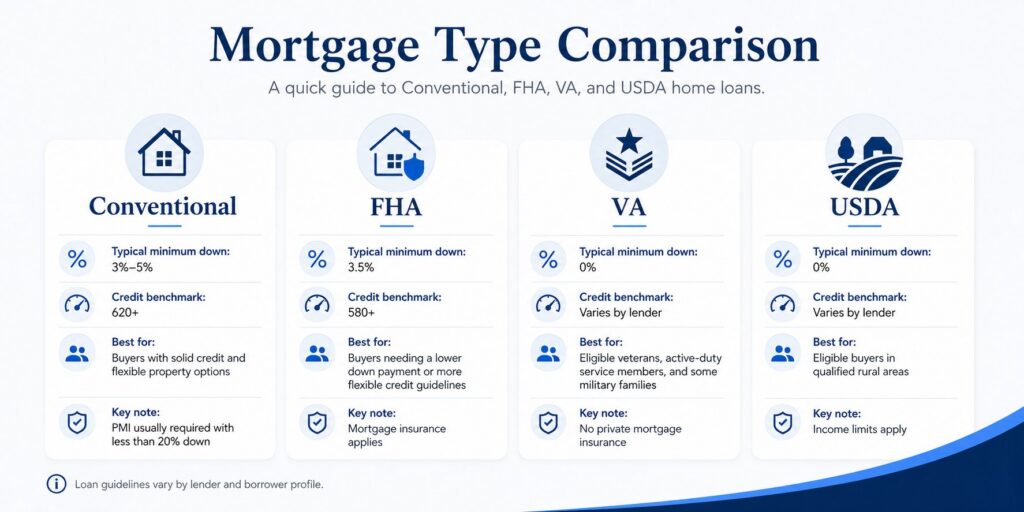
A mortgage is a loan to buy a home, secured by the property itself as collateral. If the borrower defaults, the lender can foreclose. With 2026 interest rate volatility driven by shifting Fed policy and bond yields, understanding these basics matters more than ever.
A home loan for a primary residence typically gets the best rates and lowest down payment requirements. Second homes and investment property loans come with higher rates, stricter underwriting, and larger required reserves.
Here are the main mortgage types:
- Conventional loan – offered through a bank, credit union, or private lender; typically 3–5% minimum down payment; a credit score of at least 620 is generally needed.
- FHA loan – insured by a government agency (FHA); FHA loans require a minimum down payment of 3.5% for scores of 580+.
- VA loan – for eligible veterans; often zero down payment and no private mortgage insurance.
- USDA – zero down in eligible rural areas with income limits.
A 30-year fixed mortgage locks your interest rate for the full term, giving stable monthly payments. A 5/6 ARM might start lower but resets after five years, creating payment uncertainty. Each monthly mortgage payment includes principal, interest, property taxes, homeowners insurance, and possibly mortgage insurance. Mortgage insurance is needed if the down payment is less than 20%. Factor all of these in when estimating affordability.
Check Your Credit Report and Strengthen Your Credit Score
When you apply for a mortgage, the lender will pull your full credit report from Experian, Equifax, and TransUnion. You should check your credit first. In 2026, consumers can still get free reports at AnnualCreditReport.com, and reviewing all three bureaus helps spot inaccuracies before they cost you money.
Common errors include wrong balances, closed accounts showing as open, and late payments that aren’t yours. Even one mistake can raise the interest rate you’re offered or increase your required down payment.
To dispute errors, gather supporting documentation (bank statements, receipts), submit a dispute to each bureau reporting the issue, and contact the creditor that furnished the data. Investigations typically take around 30 days.
Credit score tiers matter significantly. Lenders typically prefer a credit score of at least 620 for a conventional loan, but borrowers in the mid-700s can qualify for rates 0.5–1.5% lower than those in the mid-600s. Improving your credit score can lead to better mortgage rates and save thousands over the life of a loan.
Practical steps to raise your score in 3–12 months:
- Pay down credit card balances to keep utilization under 30%, ideally under 10%.
- Make every payment on time, including small bills.
- Avoid opening new high-limit accounts or co-signing for others.
- Avoid credit problems like large unexplained financial changes before applying.

Know How Much House You Can Afford
The maximum a lender approves is almost always more than what’s actually comfortable. Smart home buyers set their own ceiling based on real household spending, not just a lender’s formula.
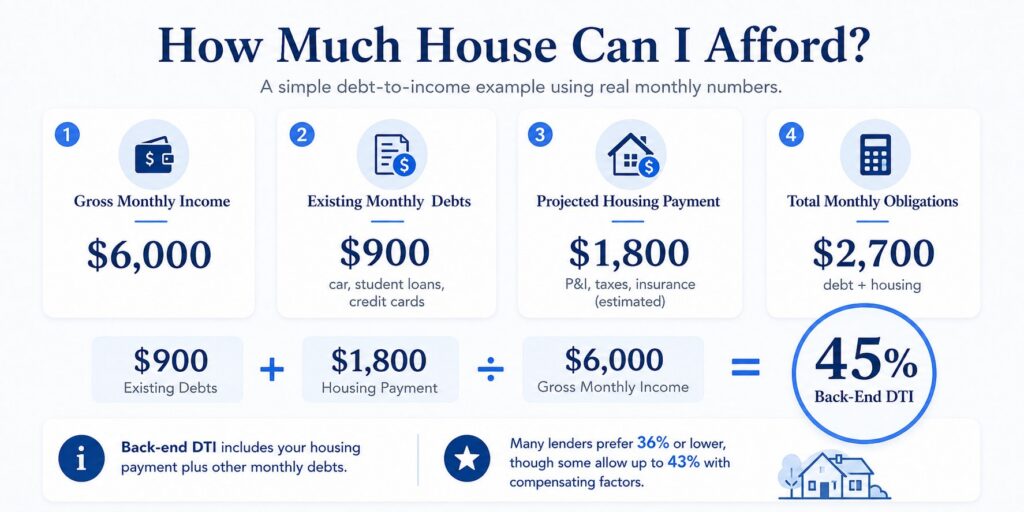
The debt to income ratio is the key metric. Front-end DTI covers housing costs only; back-end DTI includes all monthly debt obligations. Many lenders prefer a DTI of 36% or lower, though some allow up to 43% with compensating factors.
Here’s a simple example: suppose your gross monthly income is $6,000 and your current monthly debt payments total $900 (car, student loan, credit cards). That’s a 15% DTI without a mortgage. Add a projected mortgage payment of $1,800, and your back-end DTI jumps to 45%, which may push beyond what most lenders find comfortable.
Use an online affordability calculator, then review our Denver buyer payment strategy guide as you build a full household budget that accounts for utilities, childcare, transportation, groceries, and savings. Rising property taxes and home insurance costs across many markets in 2025–2026 can push your payment higher over time, so leave a 5–10% buffer.
Don’t drain your emergency savings for a bigger house. Keeping at least 3–6 months of expenses in cash reserves protects your financial situation against income shocks, surprise repairs, and the costs of home ownership that appear in year one.
Plan Your Down Payment and Upfront Costs
Your down payment size directly affects your loan amount, monthly payments, and whether you pay private mortgage insurance. A common down payment guideline is 20% of the home’s price. A 20% down payment can help avoid PMI, while the median first-time homebuyer down payment is closer to 10%.
Consider a $400,000 home purchase. At 20% down ($80,000), you borrow $320,000 with no PMI. At 5% down ($20,000), you borrow $380,000 and pay PMI until you reach 20% equity. At a 6.5% interest rate, the difference in total interest paid over 30 years is substantial. A larger down payment reduces lender risk and can improve loan terms across the board.
Common down payment sources include personal savings, liquidated investments, 401(k) loans or withdrawals (watch for taxes and penalties), and gifts from family documented with a gift letter. Many states also offer down payment assistance programs, some providing forgivable loans of $10,000–$15,000 for eligible buyers.
Don’t spend every dollar on the down payment. Moving costs, minor repairs, and furnishings in the first year require more money than most people expect.
Closing costs typically run 2–5% of the loan amount. On a $400,000 home, that’s $8,000 to $20,000 covering lender fees, appraisal ($300–$800), title search, recording fees, and prepaid taxes and insurance. Seller credits or lender credits can offset these costs, though a lender credit usually means accepting a slightly higher interest rate. Decide whether the trade-off fits your financial means and timeline.
Compare Loans, Lenders, and Mortgage Brokers
Shopping for a mortgage in 2026 can easily save thousands over the life of a home loan. Comparing multiple lenders can save borrowers thousands, and research shows that getting one additional rate quote can save $1,500 on average.
You can go directly to a bank or credit union, or work with a mortgage broker who shops multiple lenders’ pricing, guidelines, and loan terms on your behalf. A loan officer at a single institution offers only that institution’s products, while a broker accesses wholesale lenders you might not find on your own.
A local mortgage broker brings real advantages: better knowledge of neighborhood appraisals, state-specific assistance programs, and local underwriting quirks. Use Google reviews and recent online ratings to evaluate brokers and lenders. Focus on comments about communication, closing on time, and resolving issues, not just star counts.
Get at least three written loan estimate documents on the same day when possible. Comparing loans on the same day ensures accurate estimates so you can fairly compare the interest rate, APR, lender fees, and mortgage insurance. Shop for a loan within a 45-day period to minimize credit impact, since scoring models treat multiple mortgage inquiries in that window as a single hard inquiry.
Always ask a broker directly about compensation: how they’re paid, whether there are lender credits or points, and whether any prepayment penalties are hidden in the fine print. Compare all loan terms, not just the mortgage rate, to find the best deal.
Get Pre-Approved Before You House Hunt
Pre-qualification is informal, based on self-reported income and debts. Pre-approval is documented: the lender pulls your credit, verifies income and assets, and issues a conditional commitment. The mortgage application process generally involves structured steps, and key milestones include pre-approval, loan processing, and closing.
Documents you’ll need to apply for a mortgage and obtain pre-approval:
- Last 30 days of pay stubs
- Last 2 years of W-2s or tax returns (self employed borrowers should include business returns and profit/loss statements)
- 2–3 months of bank statements and financial accounts
- Government-issued ID
- Statements for all debts (student loans, car loans, credit cards)
Lenders typically look for at least two years of stable employment. A strong pre-approval letter, dated recently with a clear maximum loan amount, helps you compete in tight markets. Preapproval helps show sellers that you are a serious buyer who can perform.
Shopping for a mortgage within 45 days minimizes credit score impact because multiple inquiries are treated as one for scoring purposes. Some local brokers and lenders even offer fully underwritten pre-approvals, which make your offer nearly as strong as cash because income and assets are already verified.
Start 60–90 days before you plan to make offers. That gives you time to fix credit issues, gather documents, and get into the best programs without rate lock pressure.
Understand Loan Terms, Interest Rates, and Fine Print
The interest rate on your mortgage agreement is only one piece of the puzzle. You must read all loan terms before you sign. The Annual Percentage Rate (APR) includes many fees and gives a better picture of the loan’s total cost than the rate alone.
Loan term length also matters. A 15-year fixed on a $300,000 loan at 6.0% has higher monthly payments than a 30-year at 6.5%, but you’ll pay dramatically less total interest and own your home sooner. Buying discount points can reduce the interest rate in exchange for higher upfront fees, which may make sense if you plan to stay long-term.
Rates can change daily and should be locked in before closing. A rate lock guarantees your quoted rate for a set period (30, 45, or 60 days). In volatile 2026 conditions, locking protects you if rates rise before your closing date.
For adjustable-rate mortgages, understand the initial fixed period, the index, margin, caps, and how your payment could jump after the reset. Avoid features like prepayment penalties, balloon payments, or negative amortization unless you fully understand the risk and have a clear exit plan.
Federal law requires lenders to provide a standardized loan estimate within three business days of your loan application, and a closing disclosure at least three days before closing. Lenders must provide a loan estimate after application submission. Compare both documents carefully for last-minute changes.
Avoid Common Mortgage Mistakes Before Closing
From the moment you apply for a mortgage until closing day, your finances are under a microscope. The lender needs to verify financial information during the loan processing stage, and any major change can derail your approval.
Common pitfalls to avoid:
- Avoid opening new credit accounts during the mortgage application process.
- Don’t finance a car, take on new debt, or add a co borrower without discussing it with your lender.
- Large unexplained deposits into your financial accounts will trigger questions.
- Changing jobs mid-process can reset employment verification.
Keep all financial paperwork organized and respond quickly to underwriter requests. Responding quickly to requests for documents can help keep the mortgage process on schedule and prevent your rate lock from expiring.
A home appraisal is required by the lender to confirm the property is worth the loan amount. A home inspection is separate and evaluates the condition of the roof, plumbing, electrical, and structure. Even when not required, an inspection protects the buyer and can be a powerful negotiating tool.
At closing, expect to review the closing disclosure at least three business days in advance. Bring a certified or cashier’s check or wire funds carefully, verifying wire instructions to avoid fraud. If the numbers on the final documents don’t match expectations, pause and get clear answers before you sign. Even under time pressure, careful consideration of every line protects your money and your home purchase.

For personalized guidance on comparing lenders and choosing a loan, learn more about Integrity Mortgage and our local mortgage team.
FAQ: Practical Questions About Getting a Mortgage
Most straightforward mortgage applications close in 30 to 45 days. Complex cases involving appraisal delays, title issues, or income verification for self employed borrowers can stretch to 60 days or longer. Staying organized and responsive with documentation helps you stay on the shorter end.
It depends on your financial situation. High-interest debt like credit cards often costs more over time, and paying it down improves your debt to income ratio, which can help you qualify for a lower rate. But draining savings completely to eliminate debt leaves you without reserves. Balance both: reduce high-cost debt while maintaining enough savings to cover your down payment and several months of expenses.
A local mortgage broker offers personal service, knowledge of area appraisals and state assistance programs, and relationships with underwriters that can speed up processing. Online lenders may offer streamlined apps and competitive digital pricing. Check Google reviews for either option, focusing on recent feedback about communication, timeliness, and closing outcomes. Many home buyers find that a local broker who can shop pricing from several lenders delivers the best overall experience.
If your score temporarily lowers your buying power, delaying 6–12 months to improve it can reduce your rate by 0.5–1.0% or more, potentially saving thousands over the loan’s life. Pay down revolving balances, correct reporting errors, and avoid new debt. However, if mortgage rates are expected to rise, waiting could cost more in interest than you save from a higher score. Weigh your own credit improvement trajectory against rate forecasts before you decide.
Yes. Research consistently shows that getting one additional rate quote saves $1,500 on average. Request a loan estimate from at least three sources, including a local mortgage broker, a credit union, and a direct lender. Comparing on the same day keeps rate conditions consistent, giving you the clearest picture of which lender offers lower monthly payments and the most favorable overall terms.